
Bangladesh’s interim Chief Adviser and Nobel laureate Dr Muhammad Yunus has found himself at the centre of a major diplomatic controversy after gifting a book to a top Pakistani military official that allegedly depicted a map showing India’s Northeast region as part of a so-called “Greater Bangladesh.”
The incident, which took place in Dhaka on 26 October 2025, has triggered sharp reactions in India, with political commentators, defence analysts, and social media users condemning the gesture as “provocative” and “anti-India.” The Bangladesh government, however, has strongly denied the allegations, calling the entire controversy “false, misleading, and politically motivated.”
The Controversial Gift
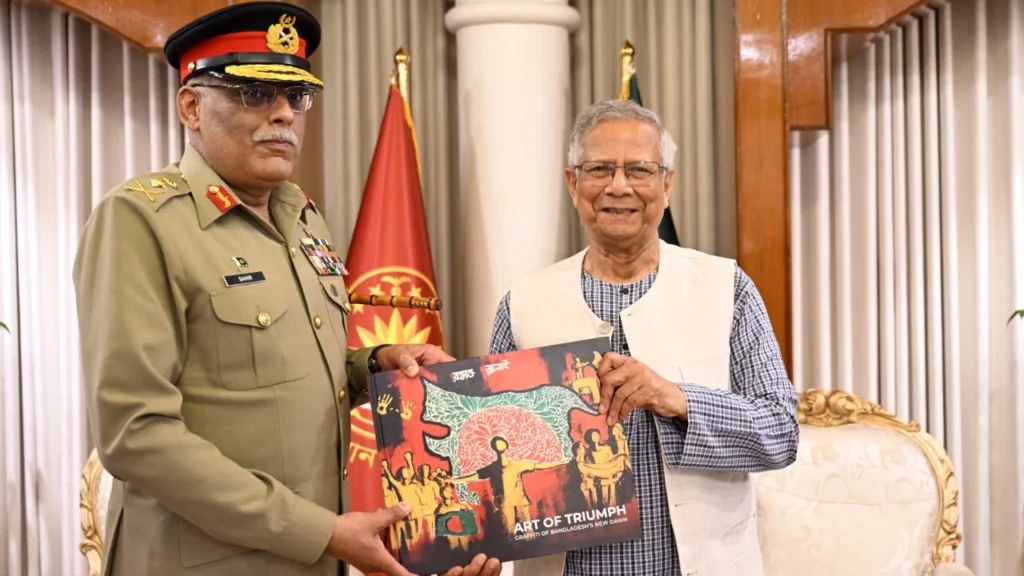
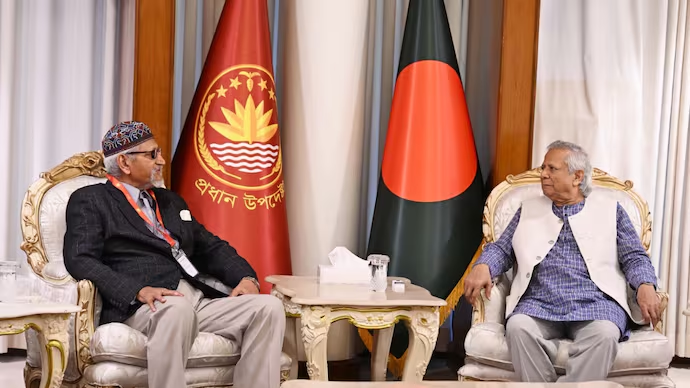
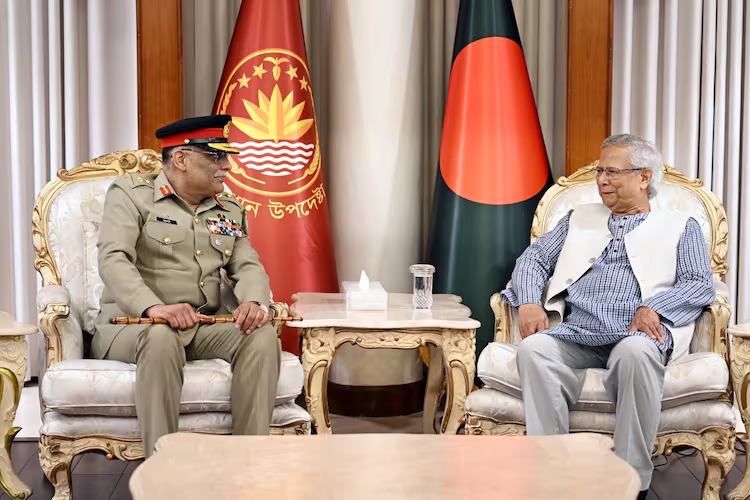
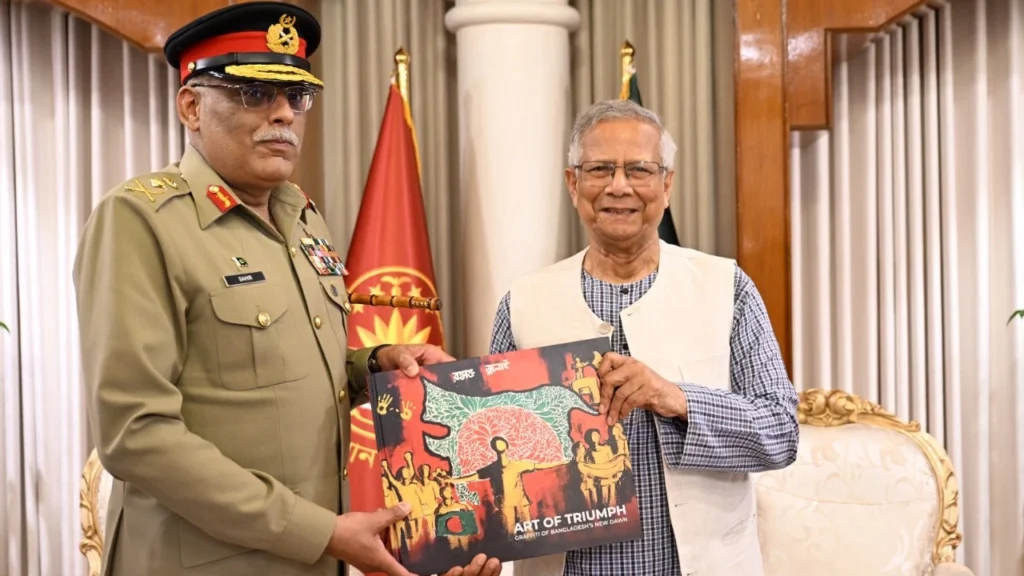
According to reports from The Economic Times, Business Today, and other South Asian media outlets, Dr Muhammad Yunus met General Sahir Shamshad Mirza, the Chairman of Pakistan’s Joint Chiefs of Staff Committee, during an official visit to Dhaka. During the meeting, Yunus presented a coffee-table book titled “The Art of Triumph: Bangladesh’s New Dawn.”
The cover of the book featured a red, stylised graphic resembling the map of Bangladesh. However, several observers pointed out that the image appeared to extend beyond Bangladesh’s internationally recognised borders, visually encompassing parts of India’s northeastern states — including Assam, Meghalaya, Tripura, and Mizoram.
Within hours, the image began circulating widely across Indian social media platforms, sparking outrage and accusations that Yunus was promoting the “Greater Bangladesh” theory — an extremist concept that envisions Bangladesh expanding its territory to include neighbouring regions based on cultural and linguistic similarities.
Outrage in India
In India, political analysts and social media users reacted strongly. The phrase “Greater Bangladesh map” trended on X (formerly Twitter), with users demanding a formal protest from the Ministry of External Affairs (MEA). Some called it a deliberate insult, while others described it as “geopolitical mischief” at a time when Bangladesh’s relations with India are already strained.
Many commentators linked the incident to Yunus’s recent remarks suggesting that India’s “landlocked Northeast” could benefit from access through Bangladesh — a statement that had already irked officials in New Delhi.
Bangladesh Government’s Response
In response to the growing backlash, the Office of the Chief Adviser in Dhaka issued a statement late Monday, categorically denying the claims made by Indian media outlets.
According to the official clarification, the book presented to the Pakistani general was a collection of street art and graffiti produced during Bangladesh’s July 2024 mass uprising, which led to the fall of Sheikh Hasina’s government. The cover image, they said, was “a creative design — not a cartographic representation.”
“The allegations that the cover shows Indian territory as part of Bangladesh are completely false and imaginary,” the statement read.
“The cover art is a stylised portrayal of Bangladesh’s national outline. It has no political or territorial implications whatsoever.”
Bangladesh’s interim government further criticised what it described as “sensationalised reporting” by certain Indian news outlets, urging the media to verify facts before “drawing conclusions that may damage bilateral relations.”
India’s Diplomatic Stand
While India’s Ministry of External Affairs has not issued a formal statement yet, official sources confirmed that New Delhi has taken note of the controversy. According to MEA insiders, the issue is being addressed through “appropriate diplomatic channels.”
Indian strategic circles, however, are reportedly viewing the incident as part of a larger pattern of provocations from Dhaka since the fall of Sheikh Hasina’s administration in August 2024. Relations between the two neighbours have grown increasingly tense amid disputes over border security, illegal crossings, and minority rights in Bangladesh.
Analysts say that the map controversy could further complicate an already delicate situation. “This is more than a misunderstanding — it reflects shifting political signals from Dhaka,” said Dr Rajnath Menon, a South Asia affairs expert based in New Delhi.
“Even symbolic acts like these carry weight. In diplomacy, perception often matters more than intent.”
Symbolism and Sensitivity
Maps and national boundaries are deeply symbolic in South Asian politics. India and Bangladesh share a 4,096-kilometre-long border, one of the longest in the world. Any perceived alteration or reinterpretation of this border — even in an artistic context — tends to provoke strong emotional and political reactions.
The concept of “Greater Bangladesh” has long existed on the fringes of political discourse. While mainstream Bangladeshi leaders have consistently rejected it, fringe groups and conspiracy theorists occasionally revive it to stoke nationalist sentiment. For India, particularly its Northeast region, such narratives are viewed as direct challenges to sovereignty and national security.
The fact that Yunus’s gift was presented to a senior Pakistani military leader — representing a country that fought a war with India over Bangladesh’s independence in 1971 — has amplified the controversy.
The Bigger Picture
Despite Dhaka’s denial, the map controversy highlights how fragile South Asian diplomacy remains. In a region where historical mistrust runs deep, even a book cover can spark geopolitical tremors.
Experts warn that both nations must act with restraint. “This is a classic example of how perception gaps can spiral into political crises,” said Kolkata-based political commentator Sushmita Bose. “Instead of reacting emotionally, both sides need to engage in quiet diplomacy.”
Conclusion
The Muhammad Yunus ‘Greater Bangladesh map’ controversy serves as a reminder of how symbols, art, and optics can ignite geopolitical sensitivities in South Asia. While Dhaka insists the map was a piece of artistic expression, India views it as an affront to its territorial integrity.
Whether the controversy fades away or escalates into a diplomatic dispute will depend on how both governments handle it in the coming days. For now, what was meant to be a goodwill gesture has turned into a public relations nightmare, straining ties between two countries that share not just borders — but also history, culture, and destiny.