
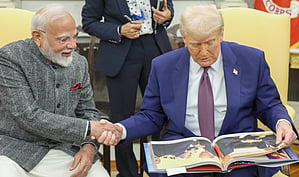


India has firmly responded to recent claims from the United States regarding the delay in the long-pending India-US trade agreement, while also addressing concerns over a proposed American bill that could impose punitive tariffs of up to 500% on certain imports. New Delhi has rejected the narrative put forward by US officials and clarified its position on both issues.
India Rejects US Claims on Trade Deal Delay
The controversy began after a senior US official suggested that the delay in finalising the bilateral trade deal was due to a lack of direct engagement at the highest political level. According to the claim, the agreement stalled because Prime Minister Narendra Modi did not personally reach out to then US President Donald Trump to push negotiations forward.
India has categorically dismissed this assertion.
The Ministry of External Affairs (MEA) termed the remarks inaccurate and misleading, stating that high-level communication between India and the United States has been regular and substantive. Indian officials pointed out that Prime Minister Modi and President Trump spoke multiple times during the period in question, and trade negotiations continued through official and diplomatic channels.
India emphasized that delays in the trade deal are due to complex negotiations involving tariffs, market access, and protection of sensitive domestic sectors—not because of any diplomatic lapse.
Trade Talks Ongoing, India Seeks Fair Agreement
New Delhi reiterated that it remains committed to concluding a balanced and mutually beneficial trade agreement with the United States. However, it stressed that India will not rush into a deal that compromises its national interests.
Indian officials highlighted that discussions are ongoing and involve technical issues related to agriculture, dairy, manufacturing, digital trade, and tariff structures. India’s position remains that any agreement must safeguard domestic industries and ensure equitable outcomes for both sides.
India Responds to Proposed US Bill on 500% Tariffs
Alongside the trade deal controversy, India also reacted to reports about a proposed US legislative bill that could impose tariffs of up to 500% on countries continuing trade with Russia, particularly in the energy sector.
The proposed bill is aimed at increasing pressure on Moscow amid the Ukraine conflict and includes secondary sanctions that could impact countries like India and China.
India’s response has been measured and cautious.
The MEA said that New Delhi is closely monitoring developments related to the bill and assessing its potential impact on global trade and energy markets. India reiterated that its energy procurement decisions are guided by national interest, affordability, and market conditions.
India Defends Its Energy Policy
Indian officials have repeatedly stated that the country’s energy strategy is driven by the need to ensure energy security for its population. India has maintained that purchasing energy from diverse sources, including Russia, is a commercial decision made in line with global market realities.
India has avoided directly criticising the US proposal but made it clear that unilateral tariff measures and sanctions can have wider economic consequences and disrupt global supply chains.
Impact on India-US Relations
Despite the differences, both sides continue to describe the India-US relationship as strong and strategic. Trade between the two countries has grown steadily in recent years, and both governments have expressed interest in expanding economic cooperation.
However, unresolved issues related to tariffs, regulatory barriers, and strategic autonomy continue to shape negotiations.
India’s response signals that while it values the partnership with the US, it will continue to assert its policy independence on trade and energy matters.
Conclusion
India has clearly rejected US claims that the delay in the bilateral trade deal was due to diplomatic inaction, asserting that negotiations are ongoing and complex. At the same time, New Delhi is carefully watching the proposed US bill that could impose steep 500% tariffs, while defending its sovereign right to make independent trade and energy decisions.
As discussions continue, the future of the India-US trade agreement will depend on both sides finding common ground without resorting to pressure tactics or unilateral measures.